Later Development
The spemann Organiser sets up the dorso-ventral axis across the blastula, this blastula to induce several developmental processes such as Gastrulation and neuralation.
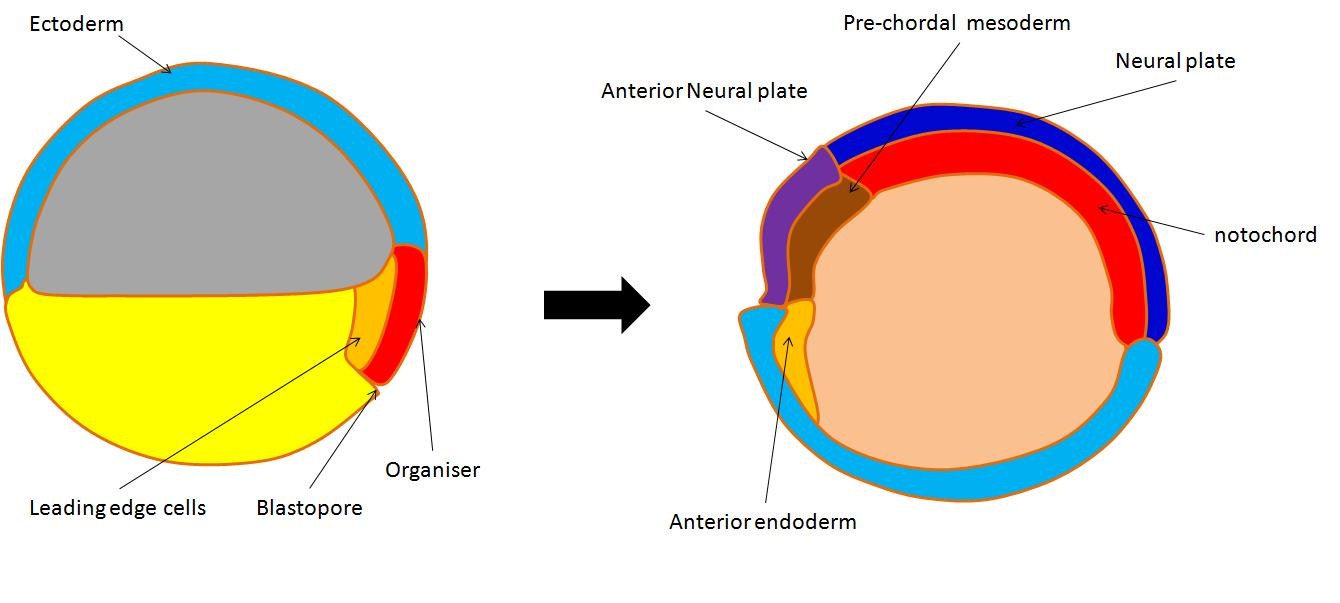
Gastrulation occurs and cells of the blastula invaginate beneath the organiser region (FIG VIII). This is known as the blastopore. From here cells known as the leading edge cells invaginate and therfore are internalised. The leading edge cells migrate along the ectodermal roof of the blastula, along with the Spemann Organiser tissue. The Organiser tissue is spread across the roof of the blastula, this allows at a later stage to develop the Anterior-Posterior axis.
Then as the Spemann Organiser as migrated, its tissue becomes a tubular structure and becomes the notochord. As the Spemann Organiser as become the notochord it starts to secrete Sonic Hedgehog (SHH) and neuralation can occur. Sonic Hedgehog secretion ventralises the neural tube.
FIG VIII: cell migration before and after gastrulation.
The Spemann Organiser is an important structure in developing embryo:
- it creates the Dorso-Ventral axis of the blastula,
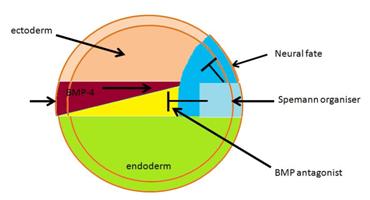
- it is also involved in inducing neural tissue from ectoderm (FIG IX). It does this by secreting BMP antagonists.
- It creates induces the creation of important structures that embryo require to survive via the processes of gastrualtion and neuralation.
FIG IX: Tissue fate map.